


You’re halfway through a ranked match. Your team’s down by two rounds. The enemy just rotated, and you need to clutch this or lose rank.
Then your brain goes blank.
That’s cognitive load hijacking your performance. Research shows high cognitive load reduces strategic thinking by making you more impulsive and less analytical. In multiplayer prisoner’s dilemma experiments—essentially gaming strategy simulations—low-load players showed superior end-game tactics while high-load players made rushed decisions.
The difference between maintaining focus and tilting isn’t about « trying harder. » It’s about understanding how your brain processes game information and optimizing around those limitations.
Here’s what actually works, backed by recent competitive gaming research.
Why Your Brain Fails Under Pressure
Cognitive load theory explains why complex HUDs and rapid decisions drain your mental resources. When you’re memorizing callouts, tracking utility cooldowns, and predicting rotations simultaneously, your working memory gets occupied. That’s when mistakes happen.
Studies from 2020-2025 on esports attention span link working memory capacity directly to cognitive ability. Players under high load exhibited less strategic defection and more period-wise mistakes. Translation: Your brain literally can’t process everything at once, so it defaults to autopilot—usually the wrong autopilot.
In tactical shooters like Valorant or Rainbow Six Siege, this manifests as tunnel vision. You focus on crosshair placement but miss the minimap callout. Or you’re so locked into utility timing that you forget to check flanks.
Battle royales amplify this. Warzone’s loot system, gas circles, loadout decisions, and third-party awareness create information overload. Your brain prioritizes immediate threats over strategic positioning, which is why you get caught rotating late.
The Equal-Skill Trap Nobody Talks About
Equal-skill competition is supposed to be ideal for improvement. Tournament theory suggests it maximizes effort—and research confirms this. Players facing equal opponents showed more attempts and longer playtime.
But here’s the catch: arousal peaks without guaranteed enjoyment gains. You’re trying harder, but you’re also more stressed. That elevated arousal can tip into anxiety if you don’t manage it properly.
This explains why ranked feels exhausting even when you’re winning. Your brain’s working overtime to maintain edge against similarly skilled players. Without recovery periods, that sustained arousal depletes your mental resources faster than stomping lobbies would.
The solution isn’t avoiding equal matches. It’s structuring sessions to account for this heightened mental cost.
Flow State Isn’t Accidental
Flow happens when challenge perfectly matches skill level. Too easy, and you’re bored. Too hard, and you’re anxious. The sweet spot keeps you engaged without overwhelming your cognitive resources.
Research on competitive agents and adaptive difficulty shows that balanced challenges lower cognitive strain compared to constantly varying difficulty. When the game adjusts to keep you in that flow zone, your learning efficiency increases without adding shame or frustration.
For competitive multiplayer, this means deliberately choosing practice scenarios that push your limits without breaking them. If you’re new to holding aggressive angles, don’t start by dry-peeking five defenders. Practice in deathmatch where respawns reduce consequence anxiety.
As your mechanical skills improve, the cognitive load of aiming decreases, freeing mental bandwidth for strategy. That’s why pros can make complex reads while maintaining perfect crosshair placement—their mechanics are automated.
Reducing Extraneous Cognitive Load
Not all mental effort contributes to improvement. Extraneous load is wasted processing power on irrelevant information.
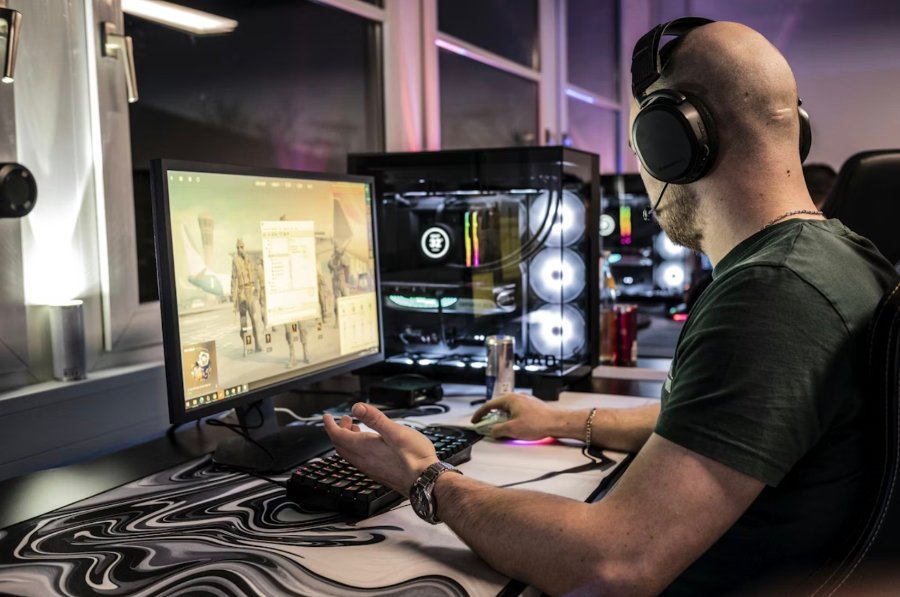
Cluttered HUDs are the biggest offender. If you’re processing six different UI elements to extract one piece of information, that’s extraneous load. Simplify your interface. Remove unnecessary notifications. Adjust opacity on non-critical elements.
Ergonomics matter more than people admit. Poor posture creates physical discomfort that demands attention. Eye strain from bad lighting diverts cognitive resources to managing fatigue. Your brain can’t distinguish between « I’m tired from bad posture » and « I’m tired from playing »—it just knows resources are depleted.
Second monitors during active gameplay create attentional strain. Every glance away is a context switch that costs working memory. Save Discord and stream chat for between rounds.
This is where tools from Battlelog.co come into play—if you want to use Battlelog.co to dominate Arc Raiders, consistency in mechanical execution is key. When your inputs are stable, your brain doesn’t waste energy compensating for variance. That freed bandwidth shifts toward higher-level strategy: reading rotations, predicting utility, and positioning for trades.
Session Structure That Respects Cognitive Limits
Extended sessions amplify load effects. Research shows low-load players converge faster to optimal strategies like subgame perfect Nash equilibrium. High-load players take longer and make more errors along the way.
Equal competition sustains effort but risks fatigue without breaks. Your brain needs recovery periods to consolidate learning and restore working memory capacity.
Here’s a structure that works:
Warm-up (15 minutes): Deathmatch or aim training. Low stakes, mechanical focus. This primes neural pathways without inducing stress.
Peak performance window (60-90 minutes): Ranked or competitive modes. Your cognitive resources are fresh. This is when you make the most progress.
Mid-session break (10-15 minutes): Physical movement, hydration, eye rest. Not scrolling your phone—that doesn’t restore working memory.
Secondary session (45-60 minutes): Lower stakes practice or casual modes. Your resources are depleted, so focus on reinforcing existing skills rather than learning new ones.
Attempting marathon sessions without respecting these cognitive cycles leads to diminishing returns. You’re not getting better after hour three—you’re ingraining bad habits because your brain’s too fatigued for proper error correction.
Mental Training Beyond « Just Focus »
High cognitive load impairs self-control and reasoning. That’s why you tilt. Your brain’s resources are occupied managing game information, leaving nothing for emotional regulation.
Mindfulness rebuilds those resources. Not mystical nonsense—literal working memory restoration through controlled attention training. Five minutes of focused breathing between matches can prevent the tilt spiral that tanks your session.
Field-dependent versus field-independent cognitive styles affect how you process team information. Field-dependent players struggle with information overload in chaotic team fights. Field-independent players handle visual complexity better but might miss social cues in comms.
Understanding your style helps optimize practice. If you’re field-dependent, practice isolating single information streams—watch VODs focused only on minimap reads, or only on utility usage. Build those skills separately before integrating them under pressure.
The Competitive Psychology Piece
Toxic teammates amplify cognitive load the same way high-memory tasks do. Your brain spends resources managing social stress instead of gameplay. Mute aggressively. Your rank will thank you.
Research on competitive agents shows that social competition can boost engagement without adding cognitive strain when it’s properly structured. Playing with friends who provide useful comms reduces load compared to randoms who tilt-type mid-round.
Equal-skill matches heighten arousal, but enjoyment peaks in wins versus ties. This creates a motivation paradox—you need equal competition to improve, but stomping feels better. Balance both. Use ranked for skill development and unranked for confidence maintenance.
Long-Term Sustainability
Sustained high cognitive load risks what researchers call bounded rationality failures—your decision-making degrades because working memory is chronically depleted. This looks like « burnout » but it’s actually overtraining your brain.
Professional players structure practice to avoid this. They alternate high-intensity scrims with low-load VOD review. They prioritize sleep because that’s when memory consolidation happens. They take full days off because cognitive recovery isn’t instant.
If you’re grinding every day and not improving, you’re probably in cognitive debt. Your brain needs time to process what you’ve learned. Forced practice when resources are depleted creates negative training—you’re literally getting worse.
Making This Actionable
Start with one change: Reduce extraneous cognitive load. Simplify your HUD. Fix your posture. Remove distractions. Measure whether your decision-making improves over one week.
Then add session structure. Respect the 90-minute peak window. Take real breaks. Notice whether you tilt less in hour two.
Finally, optimize around your cognitive style. Are you getting overwhelmed by information? Practice isolating single skills. Are you autopiloting mechanics? Add complexity gradually to rebuild strategic attention.
Gaming focus isn’t about willpower. It’s about understanding how your brain processes competitive stress and designing your practice around those limitations. Do that, and you’ll outperform players with better mechanics but worse cognitive management.
The difference between good players and great ones isn’t talent. It’s sustainable mental performance under pressure.